Value of Remodeling Projects

In earlier posts I talked about the values of energy efficiency and earthquake resistance of your home.  But, how about the values of remodeling projects that do not involve structural or energy-efficiency upgrades?

Hanley Wood LLC has published national and local data for the cost vs. value comparisons of various remodeling projects.  You may find their “Remodeling 2010-2011 Cost vs. Value Report” for the San Francisco Bay Area at their website: http://www.remodeling.hw.net/2010/costvsvalue/division/pacific/city/san-francisco–ca.aspx

Data in this report indicate that homeowners are not likely to recoup their investments from most remodeling projects.  The only exception with a positive return on investment is the replacement of the entry door with a steel one!  Given these data, why would people remodel their homes?

Here is my answer to this important question:  The value sides of the cost vs. value comparisons do not include the “utility values” (i.e. the values of the use and enjoyment of the improvements) of the remodeling projects.  In fact, the differences between the “value” and the “cost” of the projects correspond to the utility values of the improvements to home owners/sellers minus the utility values of the same improvements to buyers.  It is not surprising that the home owners/sellers who did the remodeling to fit their own needs and tastes would assign a higher value to it than the buyers who would have wanted to do it differently, or would not have done it at all.

My take on this information is that if you are about to sell your house, you should not bother with remodeling it; you will not recoup your investment.  If you are a buyer, on the other hand, you can buy a house that is not exactly what you need and want, so long as you can remodel it to fit your needs and wants.  If you intend to live in your new home for a while and enjoy the benefits of the remodeling, than you should have nothing to worry about the adverse cost vs. value comparisons.

Posted in Uncategorized | Tagged , , , | Leave a comment

My Newsletter

I am developing a monthly newsletter on current real estate trends and related information.  I would like my friends, clients, and followers to take a look at the current issue and send me their feedback.  I would be very much interested in knowing if you find the information useful, if you would be interested in reading the next issue, if the unavoidable advertising bothers you, or if you would like to have additional topics covered.  Thanks in advance.  My email is:  onder@Boomerese.com.

Here is the link to the newsletter: http://boomereserealty.housingtrendsenewsletter.com/

Posted in Uncategorized | Tagged , | Leave a comment

Can We Design for Tsunamis?

After writing my last blog, I was expecting someone to ask, “How can you design for a tsunami?”  In California we have been designing buildings to resist earthquakes since 1930’s.  Over the years our building codes have evolved and improved, based on engineering research and observations of what did and did not work in the previous earthquakes.  However, designing buildings for a tsunami is rather new.

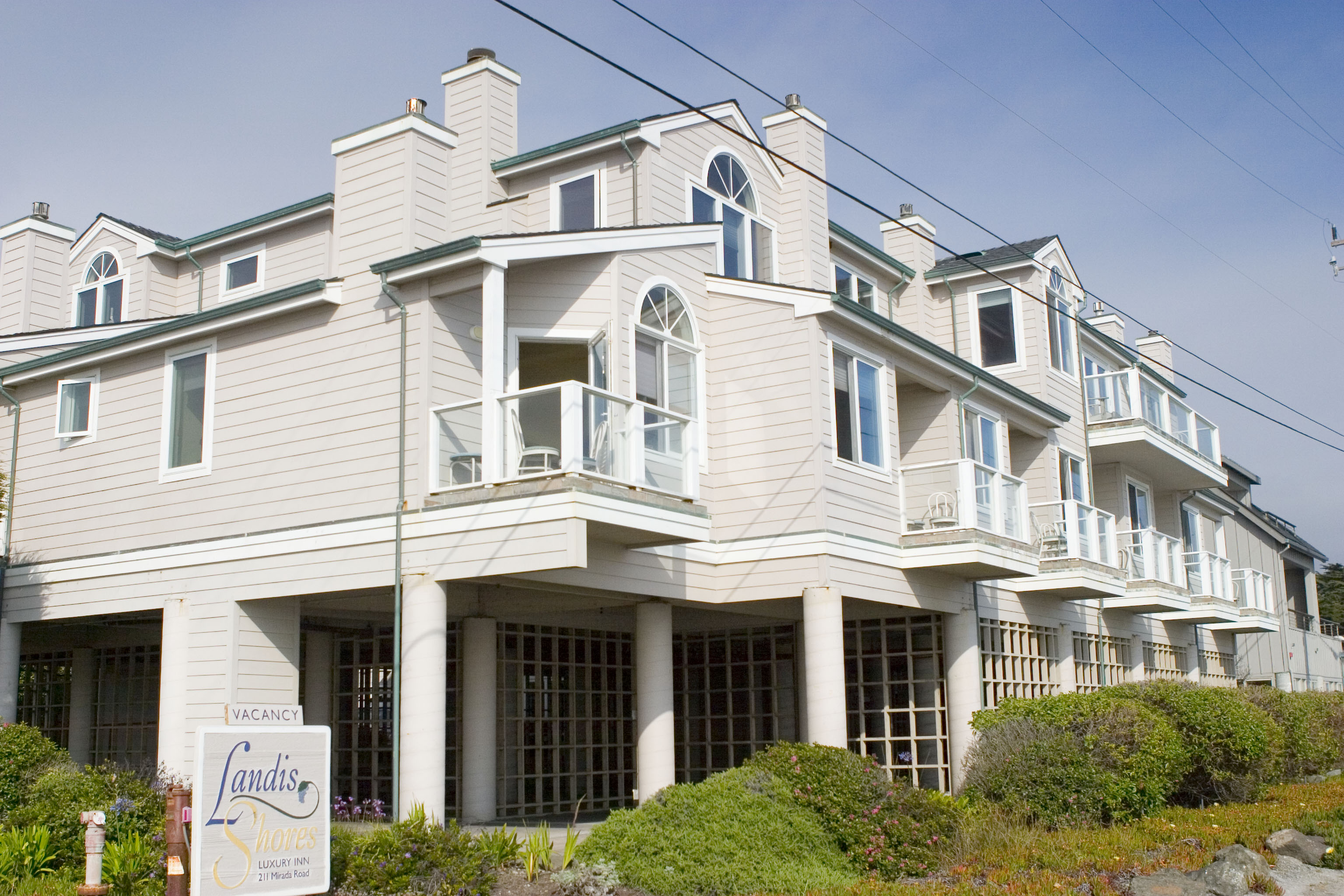
As a structural engineer, I had the opportunity to design only one building for tsunami-induced loads:  the building shown in these two pictures.  It is an ocean-front “bed & breakfast” hotel in Half Moon Bay, California.  The Architect is Robert A. Williams.  To my knowledge, this hotel was the first building ever to be designed for tsunamis in Half Moon Bay.  The design approach was to raise the whole hotel above the existing maximum wave height using reinforced concrete columns. The lattice work enclosing the first level is designed to break when hit by the waves so that they do not create drag-loads on the building.

As far as being prepared for earthquakes and its aftereffects, this building is one of the few that is prepared to the extent possible, and it should survive a tsunami without significant damage.  I said “to the extent possible” and “should” not because I am hedging my words, but because we design buildings in consideration of economic restraints to withstand the maximum loads that can reasonably be anticipated during their useful lives.  But again, that is all we can do, and in this case it is far better than many other buildings along the same shoreline.

Posted in Uncategorized | Tagged , , , , | 1 Comment

Seeing, Believing, and Earthquake Preparedness

Since I started this blog about three weeks ago and began writing about earthquakes, value of earthquake resistance, and “buying, selling, and building safe & sound homes in the San Francisco Bay Area” we had two major earthquakes.  The Magnitude 6.3 New Zealand earthquake hit Christchurch on February 21, three days after I began the blog.  Three weeks later, one of the largest earthquakes in recent history hit Japan.  People around the world watched, with horror and disbelief, video recordings of a powerful tsunami generated by the earthquake.

While I was watching the videos of the tsunami wave roaring through the Japanese countryside, it occurred to me that some of the cars, trucks, boats, and buildings that were being violently dragged by the water could have had people in them.  Some of these people were already dead and others were dying while I was watching the video.  I wondered if I was really capable of realizing how horrifying it is to be caught in that situation.  I also wondered if other people were also thinking what I was thinking.

Some people have never experienced earthquake shaking.  Until now, nobody had seen such inundation by a tsunami wave.  Referring back to my earlier blog “Myths of Loma Prieta Earthquake,” I am hoping that some of those people who thought their houses were “earthquake-proof” or “earthquakes only happened elsewhere” have changed their minds.  As they say, “seeing is believing,” and believing is the foundation of preparedness.  Let us all prepare for the next “Big One” by constructing  better buildings, retrofitting existing ones, and putting together our “earthquake kits” that would let us survive on our own for 72 hours following the earthquake.

Posted in Uncategorized | Tagged , , | 1 Comment

You can get $1,000-$4,000 rebate for improving energy efficiency of your home!

A new “Energy Upgrade California” program now offers rebates to home owners who improve energy efficiency of their homes.  For basic improvements, the rebate is $1,000.  For more extensive improvements, the rebate can be as high as $4,000.  The program is funded by the “stimulus” money and by the utility rate-payers.  You can read more about it in this article “California Program Offers Rebates…” and at the program website “Energy Upgrade California.”

Posted in Uncategorized | Tagged , , | Leave a comment

Facebook Design Charrette

I was lucky enough to be in the same picture with Mark Zuckerberg yesterday, while participating in the Facebook Design Charrette and he dropped-by.  The Charrette was organized by San Mateo Chapter of American Institute of Architects and the City of Menlo Park.  Four teams of participating architects, engineers, artists, residents, other professionals, and some Facebook employees “brainstormed” for a very long day to develop many ideas for the future residential/commercial development and preservation of habitat around the new Facebook Campus.   

Posted in Uncategorized | Leave a comment

Value of Earthquake Resistance

Foundations, walls, columns, floor and roof joists, trusses, and beams are elements that form the structural system of a building.   Structural systems carry the building’s weight, as well as the weight of its contents and occupants.  They also enable the building to withstand the forces generated by wind and earthquakes.  Plywood-sheathed “shear walls,” diagonal bracing, and steel “moment-resisting frames” are the common systems used to make a house earthquake resistant.  As the structural systems are usually hidden behind architectural finishes, their quality is not always considered in determining the fair value of residential properties.

In this article, I will concentrate on the earthquake-resisting structural systems of buildings (houses) in the San Francisco Bay Area and quantify the price premium a house with superior earthquake resistance should command.

A house with a well-designed earthquake-resisting structural system would suffer minimal or no damage when subjected to lower levels of ground shaking and incur repairable damage when subjected to strong ground shaking from large earthquakes.  A building with poorly designed structure, on the other hand, may have significant damage at lower levels of ground shaking and may be destroyed when shaken by strong ground motion.

Consider a hypothetical case of two houses (House A and House B) in the San Francisco Bay Area that are identical in appearance, except that House A has a better-designed earthquake-resisting structural system then House B.  The probability that these houses will be affected by a large earthquake in any given year is about 3.3%.  Let us assume that these houses are selling for $1,000,000 and that for House A the cost of repairs after a large earthquake will equal to 10% of its replacement value, while the repairs will cost 40% of replacement value for House B.

If we assume that the value of improvements is 50% of the total value of the property , the annualized expected repair cost (or expected loss) for House A is $1,650, while it is $6,600 for House B, for a difference of $4,950.  For a 5% capitalization rate, the value of $4,950 per year reduction in expected losses would be $99,000. 

 The implication of these numbers is that House A with the better structure should be valued at about $100,000 more than House B.  If the fair value for House A is $1,000,000, then the fair value of House B should be $900,000.

In conclusion, a well-designed structural system can add substantial value to a house, while a poorly designed structural system would reduce its value.  Unfortunately, this significant factor is not always considered in determining the fair market value of houses.  Home-buyers are advised to consult a structural engineer with expertise in earthquake resistance of structures prior to making an offer to buy a house in the San Francisco Bay Area.

Posted in Uncategorized | Tagged , , , , | 3 Comments

FACEBOOK is moving to Menlo Park

Facebook Inc. is moving its headquarters to Menlo Park, to old Sun Microsystems campus.  San Mateo Chapter of AIA is holding a “design charette” on March 5 to brainstorm about the future development around the new Facebook campus.  I am participating in the design charette.

Facebook’s move to Menlo Park is likely to have a positive impact on Menlo Park’s real estate market.  Here is a Wall Street Journal article on the topic:  “Facebook Courts Its Future Neighbors

Posted in Uncategorized | Leave a comment

Energy Efficiency Label on Houses

Some builders are planning to have energy-efficiency labels on newly constructed homes, similar to miles-per-gallon stickers on cars.  Also, DOE is apparently working on a system to rate energy efficiency of existing homes.  With such ratings it will be a lot easier to estimate and compare energy use of homes and consider it in buying and selling homes.  This ties-in with my previous article “Value of an Energy-Efficient House” (https://boomereseblog.com/2011/02/23/value-of-an-energy-efficient-house/). 

You can read the full article here:  http://content.usatoday.com/communities/greenhouse/post/2011/02/kb-builders-mpg-like-home-labels/1?loc=interstitialskip

Posted in Uncategorized | Tagged , , | Leave a comment

New Rules for Mortgage Brokers

I think you will feel better with the new rules about working through mortgage brokers.  Read here for yourself about the new rules:

http://www.nytimes.com/2011/02/20/realestate/20mort.html?_r=2&ref=realestate

Posted in Uncategorized | Tagged , , | Leave a comment