Did Housing Market Bottom?

In my last article, I pointed out that the inventory of single-family homes for sale in San Mateo County was declining, while the number of homes sold was rising. I noted that these might be “indications of a pending upward trend in prices” and that it was perhaps “the time to act for those who have been waiting on the sidelines to buy a home when the market bottoms.”

Recent news confirms my findings. According to chief economist of the National Association of Realtors ®, “”Despite the frictions related to obtaining mortgages, buyer interest remains solid. But inventory continues to shrink and that is limiting buying opportunities. This in turn is pushing up home prices in many markets”   (http://goo.gl/zdvPh).  And, Zillow claims, “The housing market has finally turned a corner (http://www.zillow.com/blog/research/2012/07/24/zillow-home-value-forecast-for-june-2013/).”

My previous article was based on sales statistics as of April 2012.  I now have the data for May and June as well.  I thought I should check and see what is new in San Mateo County.  Here is what I found:

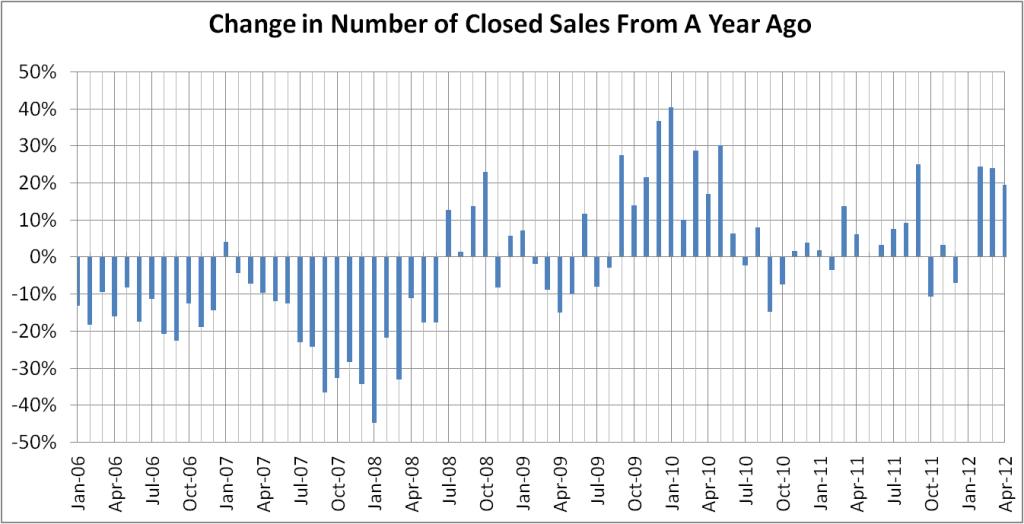
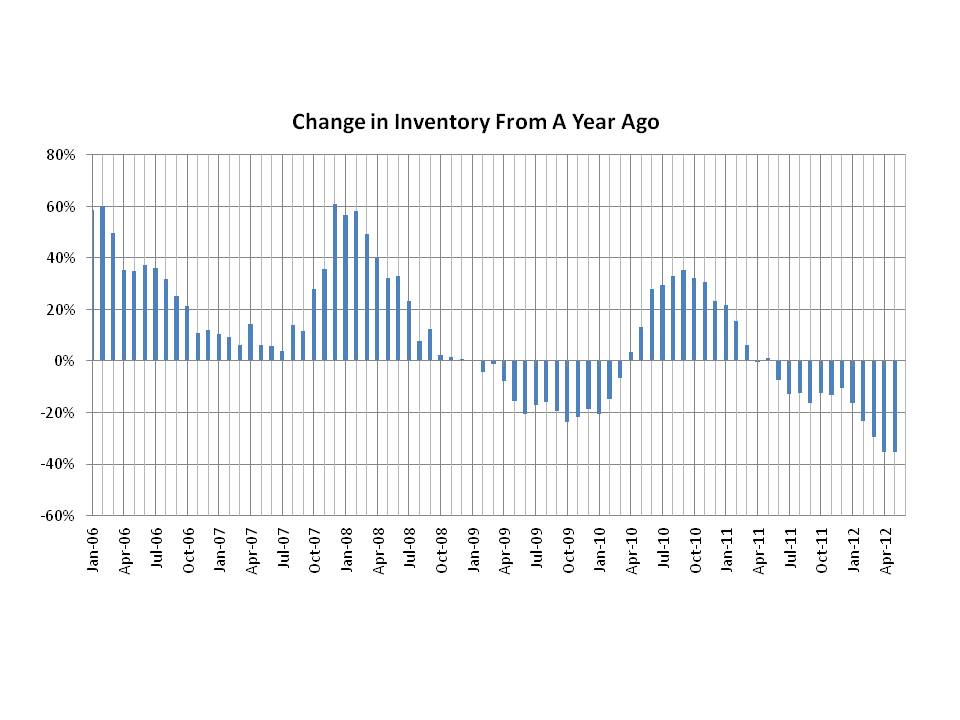
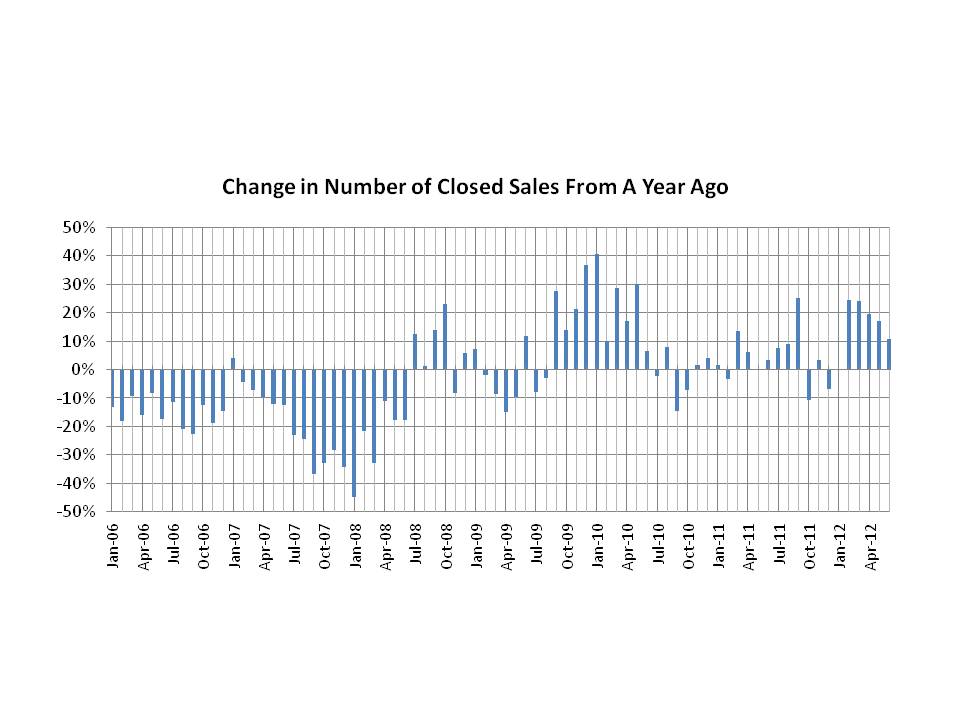
Inventories continue to be almost 40% lower than a year ago. Numbers of monthly closed sales are about 10% above last year’s numbers.
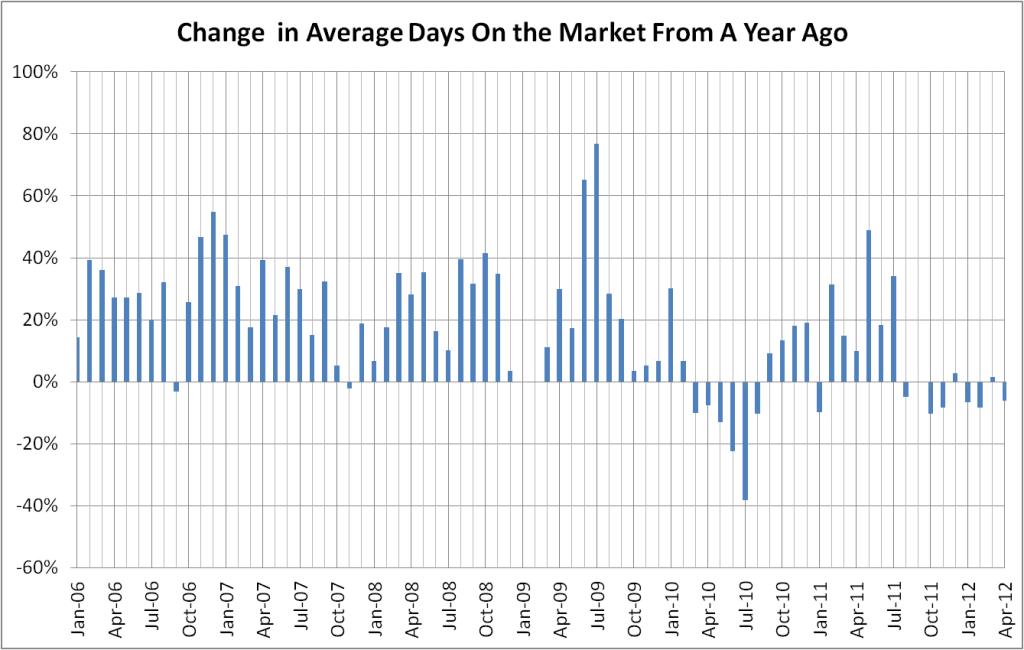
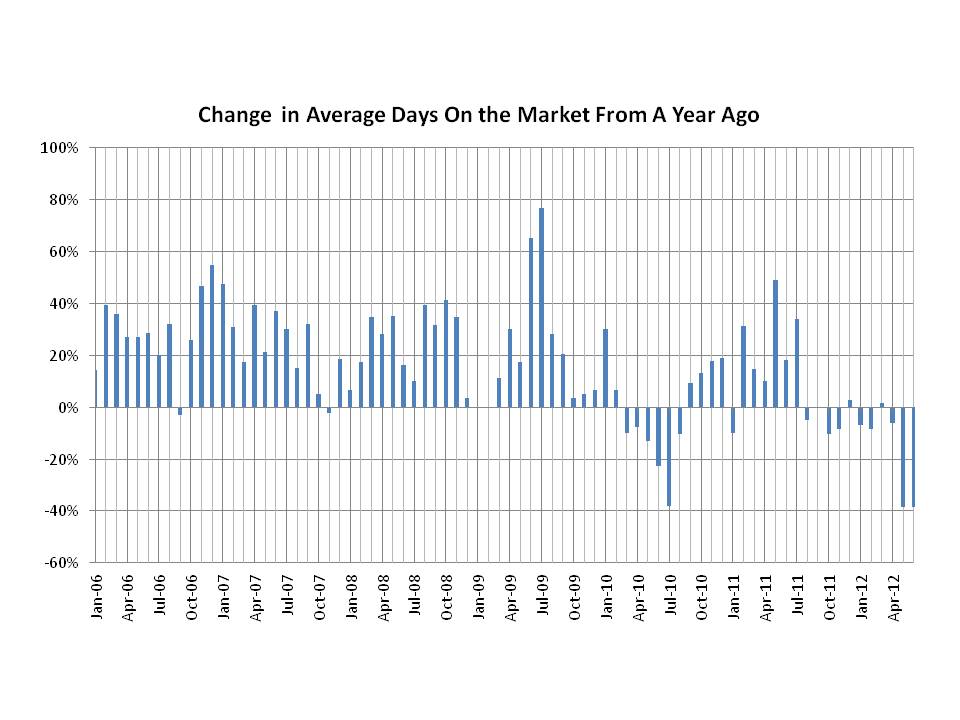
Homes have begun selling in about 40% less number of days.
Average sale price have increased by 5% from a year ago.
The data are quite convincing that the housing market might have indeed “turned a corner” or “bottomed.” While within the current political, legislative, and economic environment of many uncertainties, we should perhaps have sustained trends for longer periods of time in order to be really convinced, I am convinced enough at this time to stand by my suggestion that it may be time to act if you were waiting for the market to “bottom.” I think the bottom is here; unless you are a short-term “flipper” it would not matter in the long run whether the true bottom happened last month or it will happen in a few months from now.

Posted in Uncategorized | Tagged , , , , , , , , | Leave a comment

Current Market Trends: Single Family Home Sales in San Mateo County

I wrote in an earlier blog about the seasonal variations of real estate sales during a calendar year (Trends In Residential Real Estate In San Mateo County). Considering that these seasonal patterns are repeated every year regardless of the overall market trends, I looked at the changes of some market parameters from their values of a year earlier. For my analyses, I used the sales data for a seven-year period from 2006 to present time (raw data source: MLS through San Mateo County Association of Realtors®). The results are as follows:

The average price of homes sold in San Mateo County declined during 2008 and 2009 and recovered somewhat during 2010. It has been fluctuating since the beginning of 2011 without exhibiting any particular direction. It appears that the major price swings are behind us and the single family home prices are stable.

The inventory of single family homes for sale in San Mateo County rose during 2006, 2007, and 2008; declined in 2009 and early 2010; and, rose again during the latter part of 2010 and early 2011. The inventory has been declining since April of 2011.

The decline of the monthly single family home sales ended in July 2008. It has been fluctuating since then with an upward overall trend. The sales numbers have increased for the first three months of 2012 by about 20% over the sales numbers of the prior year.

The rise in the average number of days it took to sell homes ended in early 2010. Since then it has been fluctuating and presently remains unchanged from the year ago values.

My observation is that the single family home market in San Mateo County is now stable. The inventory of homes for sale has been decreasing in recent months from a year ago values, while the number of monthly home sales has been going up. There has been no major change from a year ago in the average sale price of the homes and the number of days they remained on the market prior to sale. However, decreasing inventory and increasing number of homes sold may be indications of a pending upward trend in prices, while the homes start selling faster. At the risk of being repetitive, I would suggest that now is perhaps the time to act for those who have been waiting on the sidelines to buy a home when the market “bottoms.”

Posted in Uncategorized | Tagged , , , , , , , , , | Leave a comment

A Steel-Framed House

Most California houses are wood-framed. Typically, the walls are built with wood studs and covered with plywood and gypsum board; floors, ceilings, and roofs are built with wood joists, rafters, and trusses. We have designed many of these.

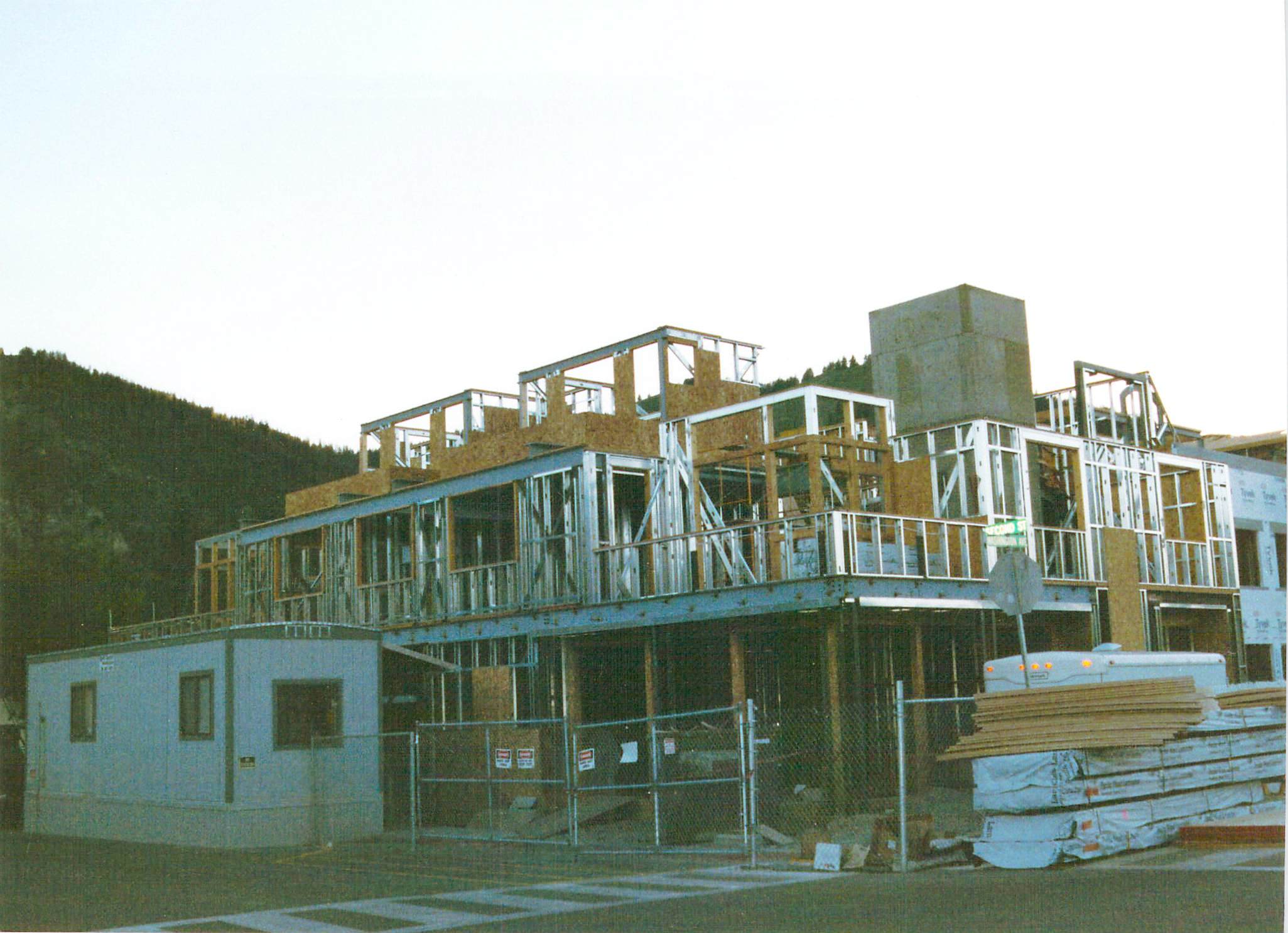
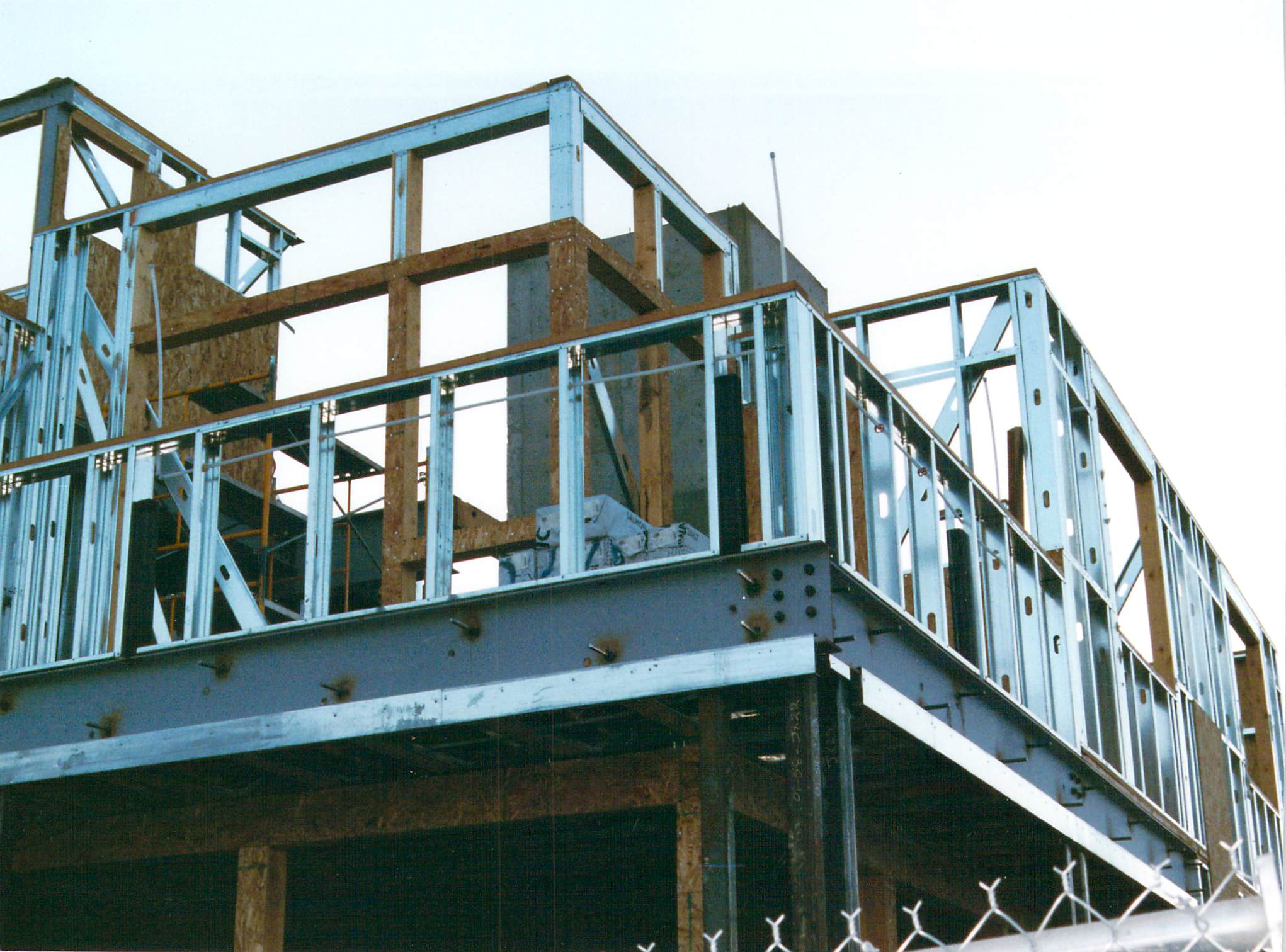
The other day I found few pictures of a “steel-framed” house that we designed a few years ago, and I thought I would share them with you. This house was custom-built for clients who wanted the house steel framed in order to save trees, increase fire-resistance of the house, and to minimize future problems due to termites and water leaks.

It turned out to be a very interesting project for us, as we had to adopt many steel construction details used in commercial construction to residential construction. Most of the structural members were steel. Lumber products were primarily used for wood nailing plates and plywood sheathing.

Here are few pictures taken during the construction.


Posted in Uncategorized | Tagged , , , , , , , , | Leave a comment

Capital Gains or Inflation Tax?

A portion of the “capital gains” on any investment is the price appreciation due to inflation. It follows that a part of the capital gains tax is an “inflation tax.” So, why don’t we separate and call it what it is: INFLATION TAX!

Let’s say that you bought a house in the Bay Area for $200,000 in 1975 (lucky you!). Now it is worth $1,500,000 (not unrealistic for some places in the Bay Area). If you sold it next year at that price, you would incur capital gains of $1,300,000. If you are married, you would be allowed an exemption of $500,000. That would bring your taxable gains to $800,000. At 20% tax rate (I assume that is what it will be next year) you would owe Uncle Sam $160,000.

Using the “Implicit Price Deflators for GDP” from the Bureau of Economic Analysis, I figured that inflation has caused prices to go up 3.375 times since 1975, and the inflation-adjusted purchase price of your house should really be $675,000. Using this adjusted purchase price, your taxable gain would be $325,000 and you would owe Uncle Sam a “real” capital gains tax of $65,000. Your inflation tax would come to $95,000, which corresponds to an inflation tax rate of 29% based on the real capital gains, or 12% based on the “fictitious” capital gains.

Now, let’s say that you invested your money into stocks and “made some money” by buying 100 shares of SPY (an ETF that reflects S&P 500) at the end of 2001 for $114.30 and sold it at the end of 2011 for $125.50. You would incur capital gains of $1,120 and pay a tax on it of $224 (I am still using the 20% rate). In reality, however, the inflation-adjusted price of SPY would be $142.81 at the end of 2011 and you would have lost $1,731. As if it was not bad enough that you did not even recover the principal you invested in the stock market, you would be “punished” by your government for being a bad investor!

With all the discussion going on whether the “capital gains” tax should be 15%, 20%, or some other rate, I wonder why nobody is asking why we have to pay an inflation tax.

Posted in Uncategorized | Tagged , , , , , | Leave a comment

A Trend in Home Remodeling: Knocking Down the Walls!

“Knocking down the walls” was the general theme of several projects we did last year at OAK Structural. In most cases, the clients wanted to remove and/or rearrange interior walls of their homes as part of a kitchen remodeling project. A majority of the clients had lived in their homes for a long time and intended to live in it after the remodel. Few clients had bought older homes and wanted to “update” the kitchen. Updating the kitchen usually involved making it bigger and opening it up to the living and dining rooms.

In the old days, people did not want to smell up the whole house when they were cooking, perhaps because the ventilation systems were not that good. They also did their cooking before the guests arrived and did not socialize while they were cooking. New homes have bigger kitchens that are open to dining and living rooms. These kitchens have granite countertops and islands, a TV, and a computer desk. Now, you can watch TV or surf the web while you are cooking and watch over your children while they are doing their homework. You can also socialize with your guests while you are cooking. With powerful vents on hoods and appliances, “smelling up the house” is no longer a problem.

If you are planning to remodel your kitchen, you should consult a structural engineer before “knocking down” a wall, as you need to know if the wall you want to remove is a bearing wall (carrying the ceiling, the floor above, or the roof) or a shear wall (helping your house resist earthquakes).

Don’t be discouraged if the wall you want to knock down turns out to be a bearing wall or a shear wall; your structural engineer will figure out how to compensate for the loss of that wall. Usually, he will design a new beam to carry the loads that the wall was carrying, and new posts and footings to support the beam. Compensating for the loss of a shear wall may require converting another wall into a shear wall, strengthening an existing shear wall, or inserting a steel frame where the wall is removed.

During the construction you will not be able to use your kitchen for a few weeks. But when it is all done, you will love your new kitchen and wonder why it was not built that way to start with.

If you are thinking of remodeling your kitchen or otherwise knocking down some walls in your home, OAK Structural and its architect and contractor partners would be happy to talk to you about your project and help you turn your thoughts into reality.

Posted in Uncategorized | Tagged , , , , , , , , | Leave a comment

How Earthquake-Resilient is Your City?

This week I attended the 2012 Northern California Earthquake Hazards Workshop at the US Geological Survey in Menlo Park. I was particularly interested in hearing the presentations and a panel discussion on “Implementing and Exporting SPUR’s Resilient City Initiative.”

SPUR (San Francisco Planning + Urban Research Association) is a non-profit organization that is intended to promote “good planning and good government in the San Francisco Bay Area.” SPUR’s Resilient City initiative is concerned about assessing and improving the earthquake resilience of San Francisco. Earthquake resilience is defined as “the extent of the habitability of homes and the continuity of services and businesses after an earthquake.”

SPUR’s preliminary estimate for the current resilience of San Francisco is 75%; that is, after a Magnitude 7.2 earthquake on the peninsula segment of the San Andreas Fault, 75% of the residential units in the City are expected to be habitable as “shelters-in-place” while they are repaired. SPUR would like to see the City’s earthquake resilience raised to 95% and it thinks this goal is achievable through careful disaster planning, strengthening of buildings, and establishment of neighborhood post-earthquake response centers.

The Resilient City initiative is driven by a fear that if a large number of residences in the City become inhabitable for an extended time following an earthquake, some people and businesses may leave the City permanently. If this were to occur, it would have a significant long-term impact on the economy of the City, its real estate market, and its living standards.

Earthquake resilience is not a concern for San Francisco only. All cities in the Bay Area are subject to similar earthquake risk, and they all have numerous soft story buildings. Furthermore, as many people live in one city and work in another, the earthquake resilience of the cities are interrelated. Such interrelation makes it imperative that other cities in the Bay Area join San Francisco’s efforts. If many cities were to pool their resources, the necessary technical work to evaluate and improve the earthquake resilience of all cities can be done better and faster. I hope they all do, and do so very soon.

I applaud SPUR’s leadership in addressing a very significant concern for the Bay Area. More information about SPUR and its activities is available at their website: www.spur.org.

Posted in Uncategorized | Tagged , , , , , , , , | Leave a comment

Trends in Residential Real Estate in San Mateo County

We are already in the third week of 2012, and I thought it would be worthwhile to review the current trends in single family residence sales in San Mateo County. I analyzed the sales data for a seven-year period from 2005 through 2011 (raw data source: MLS through San Mateo County Association of Realtors®). The results are as follows:

Average price of the homes sold in San Mateo County peaked in 2007 at $1,214,000, declined about 25% between 2007 and 2009 to $890,000, and seems to be stabilized at around $930,000 in 2011.

Average inventory of single family homes for sale in San Mateo County rose from 926 in 2005 to 1,742 in 2008. Since then it has been fluctuating between 1,500 and 1,700 homes.

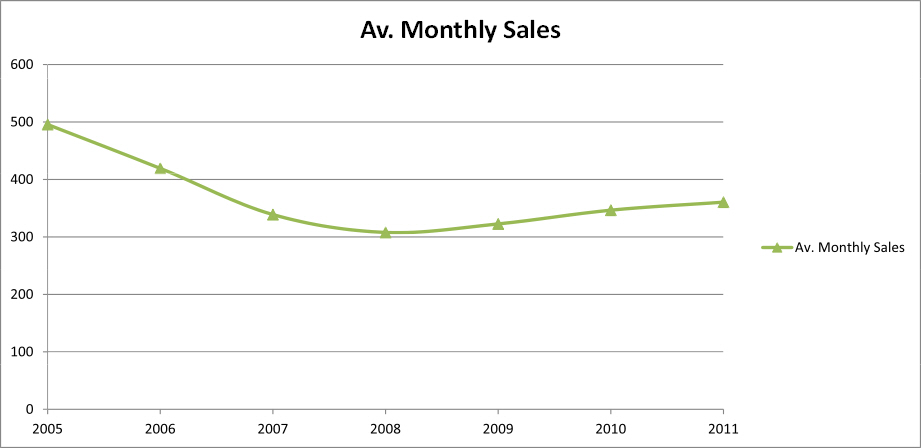
Average monthly sales of single family homes fell from 496 in 2005 to 308 in 2008. Since then the average monthly sales has been rising gradually and it stood at 361 in 2011.

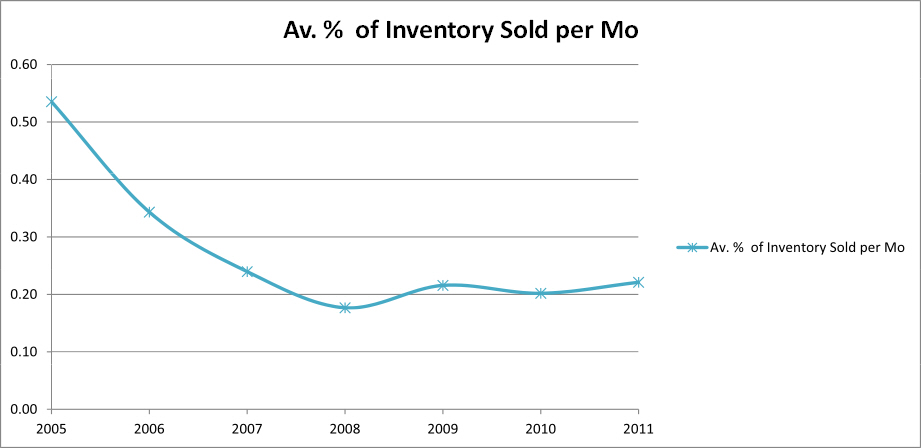
Average monthly sales as a percent of inventory of homes dropped steeply from 54% in 2005 to 18% in 2008. Since 2008, this ratio has been stable and stood at 22% in 2011.

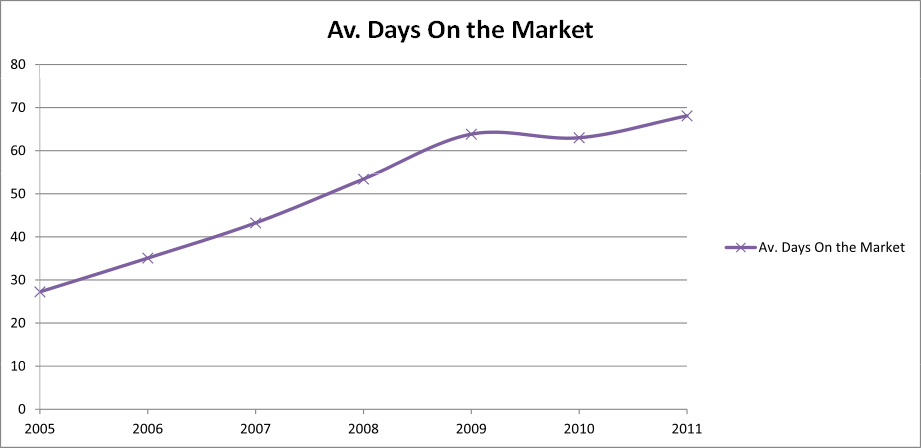
Average number of days it took to sell homes rose rapidly from 27 in 2005 to 64 in 2009. It took 63 days to sell a home in 2010, on the average, and 68 days in 2011.

In order to put all the information shown in the charts above into a single chart, I normalized the data to year 2005. The following chart shows how the five parameters noted above changed over the seven-year period in relation to what they were in 2005. It is clear that the single family residence market in San Mateo County declined significantly between 2005 and 2009, but it has been stable for the last two years. There have been slight increases in the average sale price of homes and the average monthly number of homes sold.

My interpretation of all of this information is that the single family residential real estate market in San Mateo County has bottomed between 2008 and 2009. It has been stable during the last two years, with slight improvement in the average price of homes sold and the average number of monthly home sales. It appears that it still is a “Buyer’s Market,” because: a) there were 1.76 times more homes for sale in 2011 than 2005; 2) only 22% of the inventory of homes were sold in an average month in 2011 as compared to 54% in 2005 , and; c) it took 2.5 times longer to sell a home in 2011 than it did in 2005. On the other hand, the number of home sales and the average price of homes sold have been going up at a slow pace during the last two years.

Perhaps it is time to act for those who have been waiting on the sidelines to buy a home when the market “bottoms.” It seems that the market has indeed bottomed about two years ago and it may be due for a rise if the economy shows substantial improvement in 2012. With all the sideliners jumping into the market when they realize that it is time to get in, the market rise may indeed become a steep one!

Posted in Uncategorized | Tagged , , , , , | 1 Comment

Something Is In The Air!

This New Year’s Eve we drove, as we had done several times in the past, to see the fireworks in San Francisco . As we got off the freeway and headed towards the Ferry Building, we noticed that there was a lot more traffic on The Embarcadero Street than we had seen in prior years. There were a lot more people along the Bay and more of them were arriving by the minute. As the traffic came to a halt, we realized that if we stayed on The Embarcadero, we would have to watch the fireworks through the windshield of our car. We got off The Embarcadero, fought our way around the crowds and long lines in front of parking lots, and parked below one of the Embarcadero Center buildings ten minutes before the end of 2011. We were in front of the Ferry Building a few seconds before the first rocket was fired.

The fireworks were spectacular. People cheered each rocket and each explosion. They were happy and excited as if the recession, the financial crisis, and the political turmoil went away with 2011, and that 2012 would be the greatest year ever for everyone. With such happiness, excitement, and optimism in the air, it might just be so.

Cheers!

Posted in Uncategorized | Leave a comment

Accuracy of Web-Based Home-Value Estimates

You can just type the address of a house into  certain web sites and get market value estimates for it.  Before you rely on these estimates, you need to understand the method behind them and how accurate (or inaccurate) they can be.  This Wall Street Journal article discusses the subject: http://online.wsj.com/article/SB10001424052970204554204577026131448329006.html?grcc=88888Z0&mod=WSJ_hpp_sections_personalfinance

Posted in Uncategorized | Tagged , , , , , , | Leave a comment

Energy costs to impact appraised home values and mortgage qualification standards

According to an L. A. Times article, a recently introduced bill will require Fannie Mae, Freddie Mac, and FHA to consider energy costs of homes when underwriting loans.  It will also require home appraisals to account for the energy efficiency of homes.

Read the LA Times article here:  “Factoring energy efficiency into a home’s value.”  Read my earlier blog on the value of energy efficiency here: “Value of an Energy-Efficient House.”

Posted in Uncategorized | Tagged , , , , | Leave a comment